
Principles
- The table’s story is the source. AI paints and narrates. It does not decide what happened.
- Everything is data first. Scripts, shot lists, prompts and timings live in plain files. Any picture, line or video can be rebuilt from them, so fixing one thing never means redoing everything.
- Nothing ships unchecked. Machines check first because they are fast. A person checks last, because the machines miss things (see the three-arm audit).
- Small, reversible changes. Repairs touch only the part that was wrong, and the original is kept.
Canon: where the facts come from
Everything starts from the campaign wiki: the session logs, character cards and place notes kept by the GM during play. Story that happened after the wiki stopped being updated comes from the table’s own announcements. Before a detail goes into a script, a caption or a picture, it is checked against the session log it came from. A summary is only ever a starting point.
- No invented story. Nothing is made up past the last session played. Where the record is silent, the material stays silent.
- No invented downtime. Characters whose players haven’t said what they did between sessions get no made-up backstory. That space belongs to the players.
- GM secrets stay secret. The wiki is built by a script that filters out the GM’s reference notes and anything marked as a hook or a secret. Videos and descriptions follow the same rule.
- Characters, not people. Players’ real names never appear in anything published.
- Narrators are characters too. Linzi Fairwind narrates as Rivermarch’s treasurer and chronicler. The behind-the-scenes videos use a separate studio voice.
Your changes win
This is a living campaign, so the material has to bend when the players change something. The process is built for that:
- Change the card, not the picture. A character’s look lives in their wiki card: hair, fur, scales, clothes, the things they always carry. Every prompt copies those descriptions word for word from the card. Edit the card (new armour, a scar, a different hat) and the next picture follows it.
- The newest canon outranks old art. If a portrait and the card disagree, the card wins. The portrait gets redone; the card is not bent to fit the portrait.
- One picture at a time. Each picture has its own one-line brief and its own full prompt, so a single scene can be repainted without touching the other hundred.
- One line at a time. Narration is recorded in sections. A single sentence can be re-recorded and spliced in, and the timings for everything after it update automatically.
- Time is tagged. Briefs are marked THEN or NOW, so a tent camp in year one and a walled town three years later stay different places on the same rivers.
If you want your character to look, dress or carry something differently, tell the GM. Once it is in your card, it is canon for every picture made after that.
Keeping things consistent
Early 2025 pictures were made one prompt at a time, with nothing carried over, so Linzi looked like four different people across four portraits. What changed:
- Reference images. When a scene includes a known character, their approved portrait is handed to the generator along with the prompt. It paints them into the new scene still looking like themselves.
- Style anchors. Two approved pictures set the house look. Every prompt ends with the same style line (detailed painterly fantasy illustration, warm cinematic light) and the same “no text, no logos, no borders” line.
- A shot list, not ad-hoc prompts. For the city tour, the wiki and the session logs became 104 written briefs, each expanded into a full prompt before any picture was made.
- Known traps, written down. A character’s portrait used as a style reference makes that character wander into scenes they were never in. (Tybalt turned up in six. They are in The Making Of.)
The art pipeline
- Brief. One line per picture, from the script: who, where, when (THEN or NOW), what is happening.
- Prompt. Each brief is expanded into a self-contained prompt: character descriptions from the cards, composition notes (where the subject sits, which part of the frame stays quiet for captions), style line, reference images.
- Generate. Several image workers run side by side. For the tour, eight workers made thirteen pictures each in about thirteen minutes.
- Review. Every picture is checked before it goes into a video: anatomy, the right people, the right place and time, no stray text. See checks.
- Repair, don’t replace. A defect is fixed by repainting only that region. The repaired version is lined up with the original and blended back in with a soft edge, so everything outside the region stays identical, pixel for pixel. The untouched original is kept beside it.
Narration and music
- Voice. Narration is generated with ElevenLabs (model
eleven_v4), which takes stage directions in brackets such as[warmly]or[short pause]. Each script is recorded in parts of about a thousand characters, so a fix costs one part, not the whole read. - Word timings. Every part is transcribed locally with Whisper to get the start and end of every word. The transcript is compared with the script word by word, which is how a misread word gets caught without anyone listening to twelve minutes of audio.
- Pacing. The narration is cut between lines and given room to breathe: holds on pictures, pauses before title cards. Cuts go only where there is real silence (at least 40 ms below −46 dBFS). Where the voice runs two lines together, they stay glued rather than being chopped.
- Music. “The Chronicler’s Tune” (made with Suno) plus underscore made with ElevenLabs Music. Cues change on the section title cards and duck about 17 dB under the voice. The tune is placed so its natural ending lands on the last frame.
- Loudness. A gentle limiter with headroom (no more than a few frames pushed hard), measured with EBU R128 loudness meters. Earlier mixes drove the limiter too hard and crackled; the fix and the numbers are in the production notes.
Building the videos
Videos are not edited by hand. A script (beats.json) lists every line of narration and the pictures shown during it, with optional cue words (“start this picture when she says His grandfather”). From that and the word timings, a build script writes the whole Powermove project: pans and zooms, cross-dissolves, title cards, captions and the soundtrack. A full twelve-minute rebuild takes under a minute, so changing one picture or one line means rebuilding, not re-editing.
The music video works the same way with the song in place of narration: the song file carries its own lyric timings, a shot list sets each picture against a line, and a script trims every animated clip to its slot and cuts them together. When an image-to-video model turns a face into a different person or grows a hand, we do not keep the bad seconds: the shot is trimmed to the part that holds up, or falls back to a slow camera move over the checked still.
Checks we run
Pictures
- Several independent reviewers, each with a share of the pictures, look at every picture whole and then in full-resolution crops.
- Limb tracing: name every arm and the shoulder it comes from; trace every hand to an arm; anything held must be held or supported plausibly; one head per body, tails on the right owner.
- After a repair, a fresh reviewer that has not seen anyone’s notes re-checks the repaired region.
- A person looks last.
Narration
- A whole-video transcript is compared with the script to catch wrong or missing words.
- Both sides of every cut are transcribed: each line must end on its last word and the next must start on its first.
- The sound level is measured at the edge of every inserted pause, to catch chopped words and breaths.
Video
- The project is linted for gaps and missing media before export.
- Review sheets of frames are rendered and looked at before export.
- The exported file’s audio is compared with the final mix, so a bad audio seam can’t slip through.
- Finished files are copied to the GM’s viewing machine and verified by checksum.
The three-arm audit
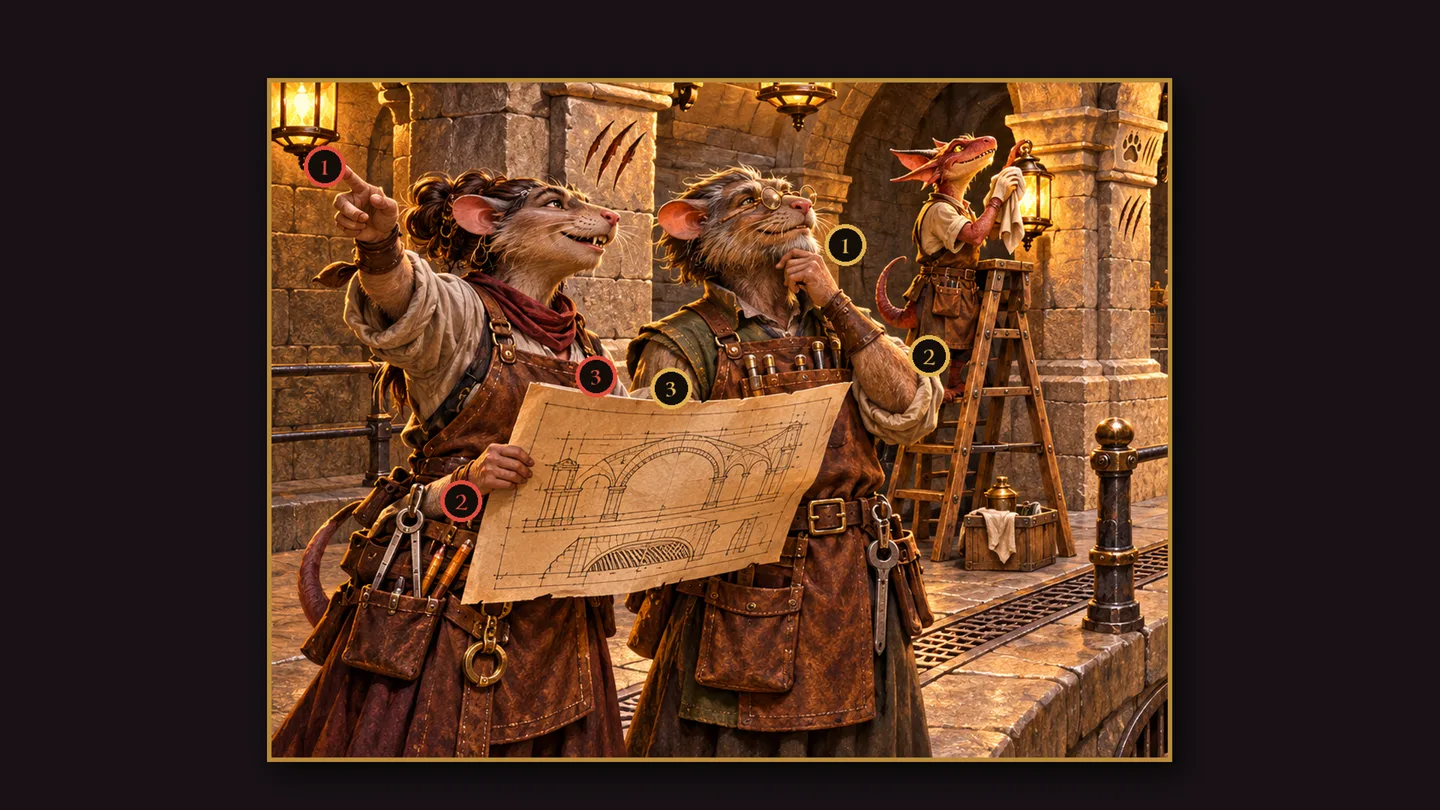
In November 2026, Stromhaven: The Making Of was finished and ready to publish when the GM spotted that the ratfolk engineer reading the blueprint in the rebuilt Warrens had three arms. That started a full audit of all 123 pictures in the city tour, split between five AI reviewers counting arms, hands and tails.
They found more three-armed figures (a ratfolk at the caravan, Kressle at Fort Crow, a kobold losing a kebab at the festival), a hand holding a sword that belonged to nobody, a ratfolk with two heads, and a pony with a rat’s tail. The reviewer who checked the Warrens picture itself passed it as fine.
The repairs had their own trouble. The first attempts kept giving the engineer a third arm somewhere else. When he finally had two, his partner still had three, and the GM caught that. The next attempt left a hand on the blueprint attached to no one, and the GM caught that too. The fix that worked was a simpler pose instead of a patched one.
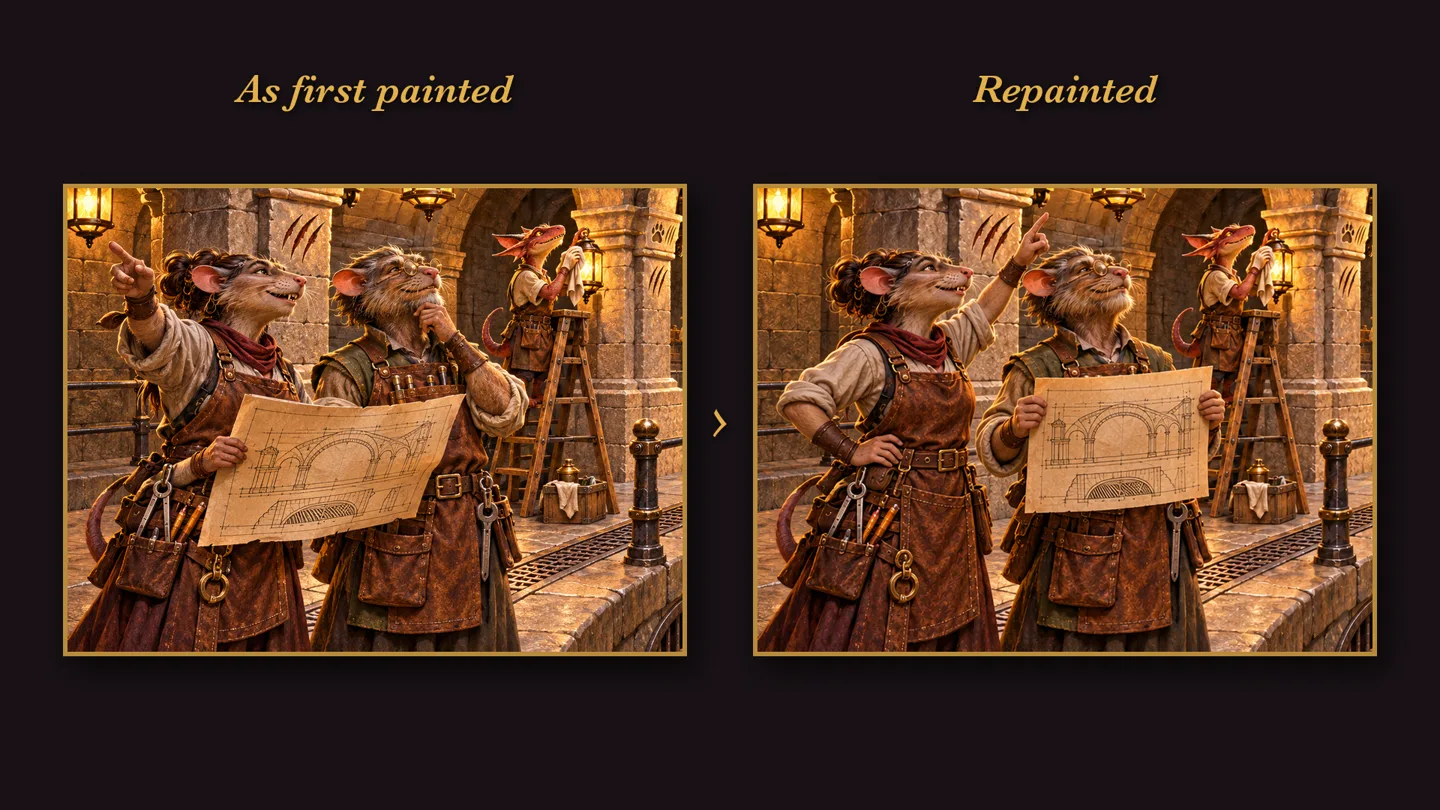
What changed because of it:
- Reviewers now trace every limb back to a shoulder instead of counting hands, because a figure can show two hands and still have three arms.
- When a repair keeps failing, change the pose to something simpler rather than patching the same pose again.
- Every repair is re-checked by a reviewer who hasn’t seen the earlier notes, and then by a person.
- The full story is the last chapter of The Making Of.
Tools
| Job | Tool (as of 12 November 2026) |
|---|---|
| Planning, scripting, checking, orchestration | Claude, working as a team of agents (one coordinates; others generate, review and verify in parallel) |
| Pictures | OpenAI image models, given reference portraits; ElevenLabs image editing for region repairs |
| Narration | ElevenLabs text-to-speech, eleven_v4 |
| Music | Suno (“The Chronicler’s Tune”), ElevenLabs Music (underscore) |
| Word timings | faster-whisper, run locally (small.en and large-v3-turbo; whichever matches the script better) |
| Editing and export | Powermove, driven by build scripts through its agent interface; ffmpeg for audio, checks and share copies |
| This wiki | Astro static site built from the campaign wiki, Pagefind search, served by Caddy |
Changelog
- 12 Nov 2026The Size of Your Crown, a music video for Mirielle’s festival song: an original song written for the scene rather than a cover, 41 new pictures, and a short animated clip for every shot. Animated clips are now checked frame by frame like the stills; where a face changed into someone else or hands multiplied, the shot uses only its clean seconds or a slow pan over the checked picture.
- 12 Nov 2026Maximus: The Warden of Rivermarch, the first character deep dive. A second narrator voice designed for Maximus; 85 pictures from Codex workers, each checked by limb-tracing and then by fresh reviewers at full resolution; prompts now require five-fingered hands and runes that never spell letters.
- 12 Nov 2026After the GM found three-armed engineers in a finished video, every picture was re-audited, nine were repainted, and the limb-tracing rule and the independent re-check were added. See “The three-arm audit” below.
- 11 Nov 2026Stromhaven: A Chronicler’s Tour and The Making Of. Shot list, reference portraits, eight image workers in parallel; narration cut only in real silence; the wiki rebuilt from the vault.
- Feb–Apr 2025The original wiki portraits: one prompt per picture, no references, no carry-over between images.